
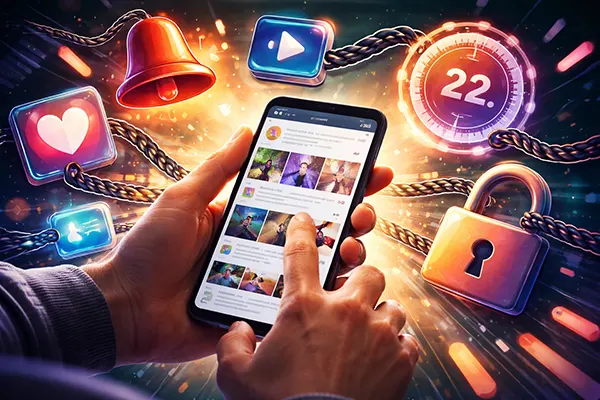
Dark patterns in social media: UX nudges that drive extra scrolling
By 2026, social media design has become more subtle and more sophisticated. Most users no longer notice individual interface tricks, yet many still find themselves scrolling longer than planned, sharing more data than intended, or accepting settings without careful thought. This behaviour is often shaped by so-called dark patterns — design choices that steer decisions in a particular direction without fully informing the user.
Common dark patterns used in social media interfaces
Dark patterns differ from standard persuasive design because they rely on imbalance. Instead of presenting options clearly, they make one choice frictionless and the alternative inconvenient. In social media, this imbalance often appears in account settings, privacy choices, and engagement features that quietly favour the service’s commercial goals.
One of the most widespread examples is confirm-shaming. Decline buttons may use emotionally loaded wording that frames refusal as careless or antisocial. Another frequent pattern is hidden controls, where privacy or notification settings are buried several layers deep, while acceptance remains one tap away.
Urgency cues are also common. Timers, alerts about “limited” visibility, or warnings that content performance may drop push users to act quickly. In many cases, the urgency is artificial, but it reduces the likelihood that someone will pause to evaluate the decision.
How interface friction extends time spent scrolling
Endless scrolling is one of the most studied engagement patterns. By removing natural stopping points, such as page breaks, the interface reduces awareness of time passing. When combined with algorithmic content ranking, each new swipe promises something potentially rewarding.
Autoplay further amplifies this effect. Videos that start without user input remove the moment where a decision to continue would normally occur. Over time, this creates a passive consumption loop where stopping feels like an interruption rather than a choice.
Exit prompts also contribute to prolonged use. Messages asking whether a user is “sure” they want to leave, or reminding them of unfinished interactions, add emotional weight to a simple action. Individually these nudges seem minor, but together they significantly increase session length.
Monetisation and consent: where dark patterns have financial impact
In 2026, social media revenue increasingly comes from microtransactions, subscriptions, and promoted visibility. These payments are often framed as small, optional upgrades, yet their presentation can strongly influence spending behaviour.
Purchase flows may highlight premium options with bright colours and large buttons, while postponing or declining is reduced to small text links. Subscription terms can be technically available but written in dense language that discourages careful reading.
Consent screens for data sharing and personalisation are another critical area. When “allow all” is visually dominant and detailed choices are hidden behind secondary menus, users are more likely to grant permissions they would otherwise limit.
Psychological pressure on vulnerable user groups
Teenagers are particularly exposed to engagement-driven design. Features such as streaks, visible read receipts, and public interaction counts leverage social pressure at a stage where peer approval plays a central role.
Users with anxiety may be more affected by loss-framed messaging. Warnings about missing updates or reduced visibility can trigger quick acceptance simply to remove the discomfort caused by the prompt.
Decision fatigue increases vulnerability for all users. After repeated prompts throughout the day, people tend to accept defaults rather than evaluate each option. Dark patterns are often designed with this fatigue in mind.

Reducing exposure to dark patterns without leaving social media
Completely abandoning social networks is unrealistic for many people, but exposure to manipulative design can be reduced. The most effective first step is controlling notifications, keeping only those that involve direct communication from known contacts.
Operating system tools provide additional protection. Time limits, scheduled downtime, and focus modes introduce external stopping points that counteract endless scroll mechanics. These tools are particularly useful in the evening, when self-control is naturally lower.
Regular permission reviews are equally important. Checking which apps have access to location, microphone, camera, and contacts helps restore balance, especially when consent was originally given under pressure.
Ethical alternatives for product and UX teams
From a design perspective, the simplest safeguard is symmetry. Accepting and refusing an option should require the same effort, use comparable language, and be equally visible on the screen.
Clear pricing and honest timelines reduce the need for urgency tactics. When users understand exactly what they are paying for and how to stop, trust increases and long-term retention often improves.
By 2026, regulatory pressure and user awareness make dark patterns a reputational risk. Teams that prioritise transparency and user autonomy are more likely to build sustainable engagement rather than short-term metrics driven by manipulation.