
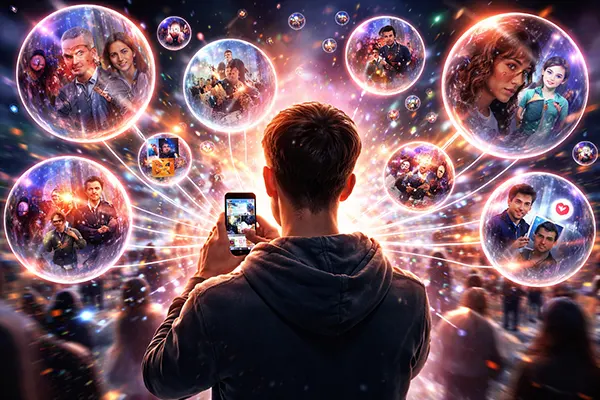
Algorithmic Traps: How Social Media Shapes Our Worldview Without Us Noticing
Most people think they “choose” what they watch, read, and believe online. In reality, social networks increasingly decide what reaches us first, what gets repeated, and what disappears. By 2025, recommendation feeds are no longer simple timelines: they are prediction engines trained to hold attention, and that attention has a direction. The result is a subtle reshaping of how we see society, politics, health, relationships, and even ourselves.
How algorithms build a personal reality
Social feeds are ranked, not “shown”. TikTok’s For You, Instagram’s Explore, YouTube recommendations, and Facebook’s feed are all built on the same principle: select content most likely to trigger a response. The system doesn’t “understand truth” or “quality” the way a human does. It understands probability: what makes you pause, replay, comment, share, or argue.
That ranking creates a personal reality that feels natural because it matches your past behaviour. If you watch two videos about a topic—fitness trends, a political scandal, a mental health story—you may quickly get twenty more, each slightly more emotionally charged. The feed becomes a loop: you react, the system learns, and your future feed narrows.
In 2025 this effect is amplified by cross-format signals. A quick scroll past a post can be treated as a negative signal, while a “save” or “rewatch” is treated as high value. Many networks also track device-level patterns such as session length, time of day usage, and whether you tend to click external links. That’s why two people searching the same topic can walk away with completely different impressions of what is “common” or “true”.
The invisible feedback loop: engagement becomes belief
The most underestimated mechanism is repetition. When the same idea appears in different formats—short clips, memes, “explainer” threads, reaction videos—it gains familiarity. Familiarity often feels like credibility, even when the claim is weak. People rarely notice this shift because it doesn’t arrive as a single persuasive argument. It arrives as a thousand small nudges.
Engagement also rewards certainty over nuance. A calm, evidence-based post is less likely to spark immediate reaction than a confident, provocative one. Over time, the feed becomes biased towards content that is emotionally efficient: outrage, fear, tribal humour, and oversimplified “takes”. This is not a moral failure of users; it is a predictable outcome of ranking systems that treat attention as success.
Once you interact with content that confirms your view, the system reads it as “satisfaction”. That is how engagement becomes belief: not because you consciously decide, but because the environment becomes saturated with one direction of interpretation. When opposing viewpoints do appear, they often arrive as distorted versions designed to trigger conflict rather than understanding.
Algorithmic traps you rarely notice until they harden
One of the biggest traps is the “filter bubble”, but it is more complex in 2025 than early descriptions suggested. It’s not only about showing you what you like—it’s about showing you what keeps you watching. That may include content you hate, content that shocks you, or content that makes you anxious. The goal is not comfort; it is retention.
Another trap is the outrage loop. Many networks have learned that anger produces quick engagement. A single inflammatory clip can travel faster than a careful investigation because it invites instant reaction. This shapes public debate: the topics that trend are not necessarily the most important, but the most emotionally explosive. Over time, people start to feel that society is more hostile, more extreme, and more polarised than it may be offline.
A third trap is identity reinforcement. If you engage with content that frames you as part of a group—political tribe, lifestyle camp, “people who know the truth”, “people who are under attack”—the feed can intensify that framing. This is powerful because identity-based content is sticky: it isn’t just information, it’s belonging. By 2025, many creators design content specifically to activate group loyalty because it stabilises their reach within a niche.
From “recommended” to “radicalised”: how the slope works
Most people imagine radicalisation as sudden: one shocking video and someone changes. In practice, it’s gradual. The recommendation chain often begins with mild curiosity—an interview snippet, a “questions mainstream media” clip, a self-help style post about “hidden causes”. Then it shifts to stronger claims, framed as “just asking” but with heavier implications.
The slope works because the system prefers escalation. If you’ve already seen the mild version, the next best hook is the sharper version. If you watched a debate clip, you might be shown a takedown clip. If you watched an explanation, you might be shown a conspiracy-flavoured version that feels more “revealing”. Each step is small enough to feel reasonable in the moment.
In 2025, this is intensified by creator ecosystems. Influencers often collaborate across adjacent niches: wellness, finance, masculinity content, political commentary, “anti-establishment” entertainment. Recommendation engines connect these networks because they share an audience pattern. The shift in worldview can happen without a person ever searching for extreme material directly.

How to protect your worldview without quitting social media
There is a difference between using social networks and being used by them. The realistic goal for 2025 is not to abandon them completely, but to reduce automatic exposure and rebuild intentional choice. That starts with recognising that your feed is not a mirror of society—it is a mirror of what holds your attention.
A practical step is to separate entertainment feeds from information feeds. For example: keep TikTok or Instagram for light content, but rely on a different habit for news—direct visits to trusted outlets, RSS, newsletters, podcasts with clear editorial standards. The more you outsource “what matters today” to a ranked feed, the more your worldview becomes a product of engagement logic.
Another step is to actively diversify your input. Follow credible sources you do not fully agree with, especially those that argue carefully rather than provocatively. Add international perspectives. Build lists on X, use “Following” feeds where possible, and reduce reliance on “For You” style ranking. These are small adjustments, but they interrupt the idea that your default feed equals reality.
Feed hygiene: small habits that change what the algorithm learns
Start by auditing your own signals. If you often watch content you dislike just to feel angry, you are teaching the system that anger is your preferred state. If you keep opening comment sections, you are signalling that conflict is engaging. If you “hate-watch” creators, you are still training the model to deliver more of that content. In 2025, the system is agnostic about your reasons—it reads only behaviour.
Use built-in controls more aggressively than most people do: “Not interested”, mute keywords, hide certain topics, unfollow accounts that push you into emotional spirals, and limit notifications to direct messages rather than trending alerts. Even simple actions like turning off autoplay can reduce the momentum of recommendation chains.
Finally, create deliberate stopping points. Endless scroll removes the natural moment to reflect. A timed session, a habit of closing the app after reading one long-form piece, or choosing a specific purpose before opening a network (“I’m checking messages, not browsing”) can restore agency. The key is not discipline as punishment, but structure as protection: it keeps your worldview from being shaped by whatever content is most efficient at grabbing your attention.